
Visit a real aerospace company: what sets this online course exchange apart
.jpg)
When a 15-year-old attends a rocket class on YouTube or follows a space engineering channel on Instagram, he learns something. When he enters the facilities of one of the largest aerospace companies in the world, talks with engineers who work with real satellites, and spends the previous week building his own rocket, he understands what he wants to do with his life.
That difference is not a metaphor. It's the core of what separates a residential aerospace exchange program in Rome from any online course available on the market. In this article, you will understand why visiting a real aerospace company transforms the profile of a young person aged 15 to 18, and how this type of access works in the program that Be Easy offers in partnership with the School of Aerospace Engineering at Sapienza University of Rome.
What can an online aerospace engineering course actually offer?
Online courses have real value. Platforms containing physics, programming, and advanced mathematics are tools that many young people use to advantage. The problem isn't the content itself. The problem is what they can't deliver.
An online course offers:
- Recorded video classes with teachers of different quality levels
- Fixation exercises and quizzes
- Certificate of completion issued by the platform itself
- Access to forums or question groups
What an online course doesn't offer:
- Contact with engineers who actively work in the aerospace industry
- Access to real laboratories at a leading university
- The experience of building and launching a rocket with your own hands
- A visit to the interior of a company in the sector with real projects taking place
For those who just want to learn the fundamentals, an online course will do the trick. For those who want to test whether aerospace engineering is really the path they want to follow, the online course is insufficient.
What happens when a young person visits a real aerospace company?
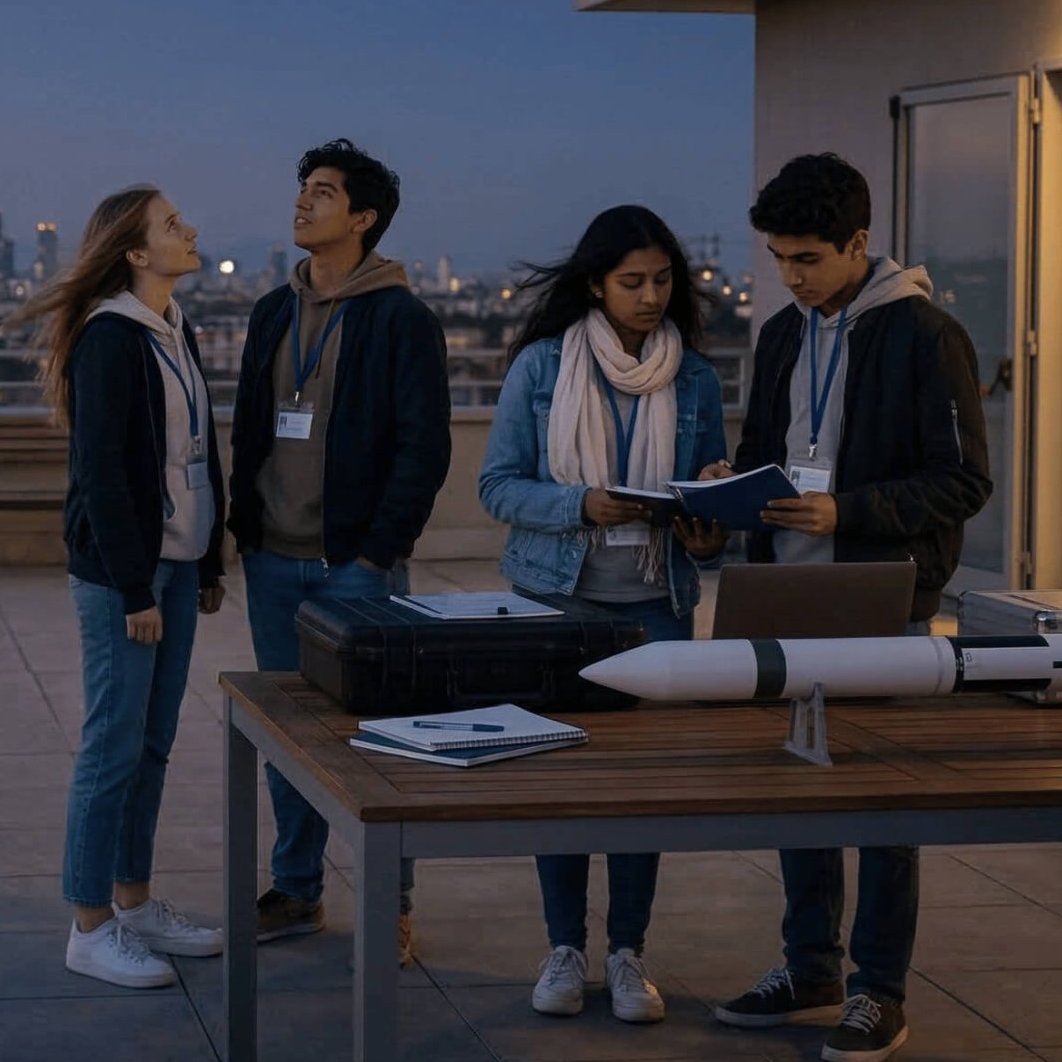
The visit to a leading global aerospace company is one of the most highlighted moments by participants of Be Easy aerospace engineering exchange program. The contact is not a tourist. It's educational and technical.
The young man comes to the company after an intense week of laboratories at the Sapienza University of Rome, where he has already studied the fundamentals of propulsion, simulation of trajectories with OpenRocket and the development of embedded systems with Arduino. He already has vocabulary. You already understand what thrust is, what telemetry is, what a flight control system is.
With this context, the company visit becomes a conversation between peers, not a presentation for tourists.
What the young person finds during the visit:
- Engineers explaining ongoing projects in their real languages
- Organizational structure of a large aerospace company: how engineering teams are divided, how projects move forward, what are the most requested specialties
- Equipment and systems that until a week ago were just theory in handouts
- Professionals talking about real career trajectories, how they got where they are and what the market values
For many participants, this is their first contact with someone who works professionally with satellites, radars, or navigation systems. It's not a detail. It is a reference point that remains for life.
Why doesn't this visit take place in online courses?
The simple answer is that no digital platform can negotiate access to aerospace company facilities for adolescent students. This type of partnership is built over years and depends on the institutional credibility, geographical location, and real history of high-level educational programs.
The program in Rome exists within the Sapienza School of Aerospace Engineering, founded in 1926 and a partner of agencies such as the Italian Space Agency (ASI) and the European Space Agency (ESA). This position in the Italian aerospace ecosystem is what enables access that a 16-year-old would hardly obtain otherwise.
An online course from São Paulo, Dublin, or Berlin cannot replicate this. Not because the content is inferior. But because physical access to a real industrial environment is, by definition, something that only exists in person, in a specific place, with specific partnerships.
How does the visit fit into the program structure?
O aerospace engineering summer camp in Rome there are two moments that shape the young person's profile in a complementary way.
What happens before the visit?
During the first week and a half, participants undergo three progressive technical modules at the Sapienza laboratories:
- Rocket Engineering & Propulsion: Foundations of Propulsion and Flight Physics
- Space Mission Simulation & Embedded Systems: trajectory simulation with OpenRocket and development with Arduino
- Rocket Prototype Development & Launch: construction of the rocket prototype and preparation for the actual launch
Upon arriving at the company, the young man is no longer an inquisitive high school student. He is someone who spent days building electronic circuits to control rocket systems and who will launch a real prototype at the end of the program.
What happens after the visit?
The launch of the rocket in Rovigo ends the cycle. The young man who visited an aerospace company, talked to engineers and understands how real projects work, now launches the rocket he designed and built with his own team.
This sequence has a clear pedagogical logic: theory, contact with the market, high-level practice. It's not possible to simulate this in any online format.
What changes in the young man's profile after this visit?
Parents who follow the return of their children describe concrete changes in the way they talk about the future. It's not vague enthusiasm. It's technical vocabulary, real references and, above all, certainty or conscious redirection.
The most observed effects include:
- Clarity about what aerospace engineering is in practice, not just in books
- Ability to articulate which specialties within the area are most compatible with the personal profile
- Concrete career references that would never exist without direct contact with professionals in the sector
- Objective differential in the curriculum and in applications for international universities, with the certificate issued by the program at Sapienza
For young people who are still discovering what they want to do, this visit works as a filter. For those who were already sure, it reinforces the decision with much more solid foundations than any distance learning course could offer.
How do logistics work for parents?
For families that have never sent a child to an international program, the practical question is legitimate. Here's how the program works:
The format is exclusively residential. The young people are accommodated in a university residence in the center of Rome for two weeks, with a single room, meals included and support from the Be Easy team 24 hours a day.
The excursions, including the visit to the aerospace company and the launch of the rocket in Rovigo, are always accompanied by the team. There are no autonomous trips. The entire itinerary is organized by the program.
The package includes:
- Accommodation for 13 nights in a university residence in the center of Rome
- 3 daily meals (coffee, lunch and dinner)
- All technical modules in the Sapienza laboratories
- Visit the leading global aerospace company
- Rocket launch in Rovigo
- Cultural tours of Rome
- Full travel insurance
- 24-hour support from the Be Easy team
- Certificate of completion of the program
To understand the registration process and guarantee a place for Summer 2026, contact Be Easy through the channel of your choice.
Frequently asked questions about visiting an aerospace company at the exchange
Does the young person need to have technical knowledge before the visit?No. The Sapienza modules are designed to build this knowledge progressively. When the visit takes place, the participant already has the necessary technical vocabulary to accompany and interact with the engineers.
Is a visit to the aerospace company guaranteed for all participants?Yes. It forms part of the official structure of the residential program. All registrants participate, without exception.
What language does the visit take place in?In English, with support from the Be Easy team. The program accepts young people of all levels of English, and the technical context built during the modules facilitates understanding during the visit.
Does the program teach the same content as an online aerospace engineering course?The technical content overlaps in part, but the format is radically different. The program works on engineering in a real laboratory, with practical projects, prototype construction, and contact with the market. Online courses don't offer this type of immersion.
How does this exchange help with applying to international universities?The certificate issued by the program refers to participation in laboratories at the Sapienza University of Rome's Aerospace Engineering School, one of the oldest in Europe. Combined with the practical experience described, it is a concrete differential in applications for engineering degrees abroad.
Be Easy
Be Easy selects each program from its portfolio based on rigorous criteria of technical relevance and real educational value. The aerospace program in Rome is part of a curatorship built over years, with more than 200 international educational partnerships. If you want to understand if this program is the right path for your child, contact us.

