
Prince George at Eton College: how to study at British boarding schools

On 16 June 2026, Kensington Palace confirmed what months of speculation had anticipated: Prince George will attend Eton College from September, following in the footsteps of his father, Prince William, and his uncle, Prince Harry. The news turned the global spotlight back on an educational model that has existed for centuries in England and that, until a few years ago, seemed reserved for families whose surnames appeared on generational waiting lists.
That is no longer the case. Families from different countries have structured access to high-level British boarding schools through specialist consultancy, without needing to be royalty or to know anyone on the inside. The process exists, has clear steps, and starts well before most people imagine.
What is a British boarding school and how does it differ from conventional schools?
A British boarding school is a residential school. The student lives, studies, and socialises with peers from dozens of countries throughout the entire school year. The curriculum goes beyond classes: sports, arts, debates, and community projects are part of the education, not after-school activities.
The British academic system operates in two main stages:
- GCSE (General Certificate of Secondary Education): a two-year course, generally taken between the ages of 14 and 16, with assessment by subject. It is the equivalent of lower secondary education and the basis for progression to the next stages.
- A-Levels (Advanced Level Qualifications): a two-year course, from 16 to 18 years of age, focused on three or four subjects chosen by the student. A-Level grades are the main criterion for admission to British universities and are widely recognised by universities across Europe, the USA, and Canada.
Schools such as Eton College, Winchester College, and Charterhouse School are benchmarks for their A-Level programmes.
The Cambridge A-Level preparatory programme for international students is a differentiator that few school systems outside England replicate.
Boarding school or high school: what is the difference for family planning
The most practical distinction between the two formats is the living arrangement, not just the content:
- High school is secondary education in a non-residential or semi-residential format. The student lives with a host family or in an apartment, attends school during the day, and has greater autonomy over their free time. It suits teenagers who are mature enough to manage their own routine.
- Boarding school is full residential education. The student lives on campus, shares a dormitory and meals with international peers, and takes part in supervised activities in the evenings and at weekends. It is a more structured environment that fully replaces the home setting during term time.
The central question is: can your child manage their own routine in a new environment? The boarding school vs. high school guide helps families make this assessment.
The choice depends on age, level of independence, and academic goals. For families considering the United Kingdom, the boarding model is no longer less accessible than high school. The difference lies in the curation, which requires preparation 12 to 18 months in advance.
How the admissions process works at British boarding schools
Admission to high-standard British boarding schools does not happen on short notice. The process has stages and deadlines that families need to track at least a year in advance, and in some cases even earlier.
The typical steps include:
- Registration and expression of interest: many schools require formal registration before opening the application process. Eton has a history of interest lists that form years before the intended entry date.
- Entrance examinations: most boarding schools administer their own tests in English, mathematics, and reasoning. Some use the Common Entrance Examination, the standardised British test for admission to independent secondary schools.
- Personal interview: unlike systems based solely on grades, British boarding schools assess the student in person. The interview tests communication, intellectual curiosity, and the ability to argue a position.
- Documentation: academic records, teachers' reference letters, and in many cases a portfolio of extracurricular activities.
- Student visa: for international students, the UK student visa requires proof of formal enrolment, financial support, and health documentation.
The process is manageable, but it demands coordination. Families who try to navigate it on their own often miss deadlines or underestimate the weight of the interview. The high school abroad curation organises every stage with the family, from the first contact with the school to the student's arrival.
Eton College: what Prince George's choice reveals about the model
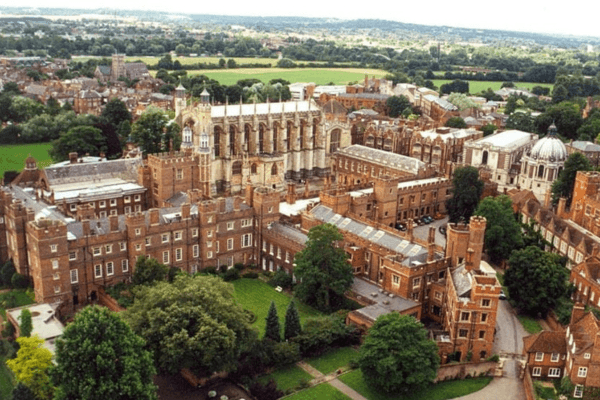
Eton was founded in 1440 by King Henry VI and is located in Windsor, Berkshire, a few kilometres from the royal castle. It educates boys exclusively from the ages of 13 to 18 and counts 20 British Prime Ministers among its alumni.
Prince George will join the school in September 2026, following his father William and his uncle Harry. The decision signals what the model delivers:
- A high-demand intellectual environment with small classes and individualised tutoring.
- A global peer network, with students from dozens of countries living together on the same campus.
- The "housemaster" system: each student has a teacher responsible for their personal and academic development throughout their time at the school.
What the news makes more visible is that Eton is not an isolated exception. The United Kingdom has dozens of boarding schools with a similar standard of curriculum and university recognition.
British boarding schools: how to study at Eton College is the starting point for families who want to understand the complete admissions process.
Other high-standard British boarding schools: what the real map includes
Choosing the United Kingdom does not begin and end with Eton. The country has a dense ecosystem of residential schools with international standards, each with its own admissions profile and curricular focus.
Some references within the Be Easy curation:
- Winchester College: founded in 1382, Winchester is one of the world's oldest boarding schools, with a focus on academic rigour and critical thinking. Winchester College sports camps are an entry point for families who want to experience the environment before committing to a full admissions process.
- Mill Hill School, London: a boarding school with a campus within Greater London, a strong international student presence, and a recognised A-Level programme. Mill Hill School also offers summer short courses, which serve as short-stay immersions for families who want to evaluate the British environment before a year-long commitment.
- Aldenham School: a school with a more personalised profile, smaller classes, and individual attention. The admissions process at Aldenham School is less competitive than Eton, with a similar focus on holistic education and a complete British curriculum.
- Bournemouth Collegiate School: an option in southern England with a strong sports programme and complete British curriculum. Bournemouth Collegiate School serves international students with integrated adaptation support.
What sets each school apart is not just a ranking: it is the student profile that best fits each environment. A family whose child excels in sports will have a very different experience at a school with a robust sports programme than at one focused exclusively on science and mathematics.
The British curriculum remains the most globally recognised benchmark for secondary education. The European boarding schools overview is useful for families comparing the British model with the continental one before choosing their destination.
Frequently asked questions about British boarding schools
Does my child need to be fluent in English to enter a British boarding school?
The school requires an intermediate-to-advanced level of English, verified by exam. Students with basic English will not pass the entrance tests, but there are preparatory programmes of 3 to 6 months that raise the level before the formal application. These programmes are part of the planning that the consultancy builds with each family before starting the process.
How far in advance does the family need to start the process for a boarding school in the UK?
The ideal timeframe is 12 to 18 months before the intended entry date. Schools like Eton have interest lists that need to be activated even earlier in some cases. Starting the process less than 6 months in advance reduces the available options and the quality of accessible schools.
Is it difficult to obtain a UK student visa for a teenager attending a boarding school?
The British Student Visa for minors requires a formal letter of acceptance from the school, proof of financial support from the parents, and in some cases proof of language ability. The process follows a predictable path when documentation is organised from the outset. The consultancy accompanies every stage of the application.
Do British boarding schools accept students of all genders, or are they exclusively for boys?
The majority of high-level British boarding schools accept students of all genders. Eton College is a historical exception: it has educated boys exclusively since 1440. Winchester College is also boys-only. Charterhouse School, Mill Hill, and Aldenham School are co-educational and have a strong presence of students from diverse backgrounds.
Is a diploma from a British boarding school recognised for university entry outside the UK?
British A-Levels are widely recognised by universities in the USA, Canada, and Europe. American and Canadian universities accept them as equivalent to a high school diploma, and many offer additional credits for high grades. It is one of the most internationally recognised secondary education systems currently available.
Be Easy: boutique international education consultancy
Be Easy supports families who want to give their child a genuine advantage before university. If your child is interested in a British boarding school, we have the right curation to help them build that path in the right environment, with a dedicated senior consultant at every stage. Contact us to receive specialist senior consultancy!

