
Outdoor tennis summer camp for young athletes: how does it work?
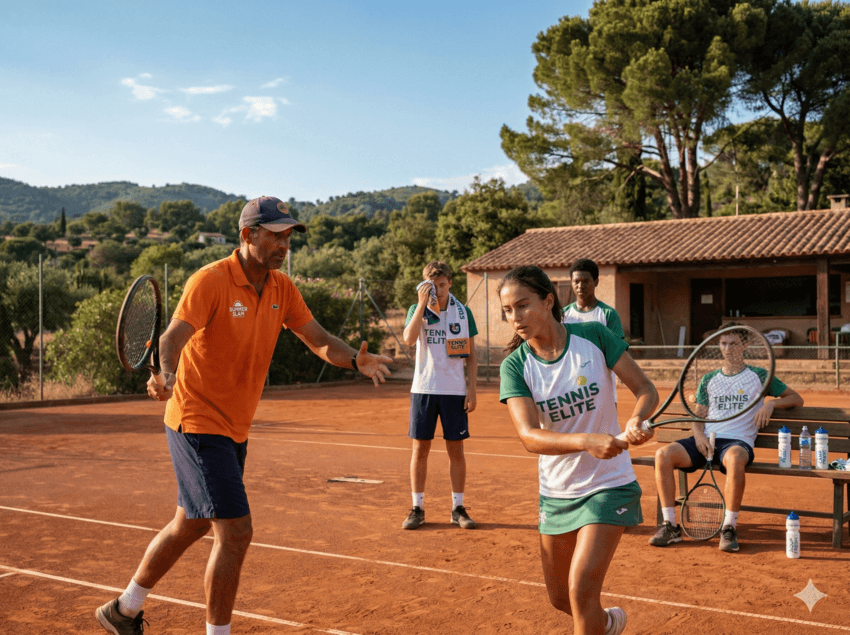
O outdoor tennis summer camp It is an intensive training program lasting 2 to 8 weeks, carried out during the summer in the Northern Hemisphere, between June and August. It brings together young athletes of various nationalities in high-level academies in the USA, England and Italy, combining daily technical training with English language development, physical conditioning and cultural immersion. For parents who are still evaluating whether the exchange makes sense for their child, this format is the smartest starting point.
In this article, you will understand how the routine of a tennis summer camp works, what destinations are available, who can participate, and why this experience is often decisive for families who then move on to longer programs. If you want a complete overview of all tennis exchange formats, check out the Tennis exchange: the complete guide for parents.
What is an outdoor tennis summer camp?
O Summer tennis camp is a sports immersion program with a professional structure. The young person lives in their own gym or in an associated residence, trains every day with coaches trained for this level of requirement and lives with athletes from other countries throughout the experience.
It's not an extracurricular vacation course. It is a routine with fixed hours of technical training, physical conditioning sessions, competitive practice, and complementary activities off the court. English is practiced naturally, because it is the only common language among the participants.
The duration varies according to the family's purpose:
- 2 weeks: first contact with the international environment, ideal for younger athletes or for families who want an evaluation experience.
- 4 weeks: The format most sought after by families, balances depth of training with the necessary adaptation for young people to make the most of the experience.
- 8 weeks: suitable for athletes who already have clearer goals and want significant technical and physical progress before deciding on a long-term program.
Why is summer camp considered the right first step?
Most families that come to Be Easy are still uncertain about their child's level of commitment to their sports career. This question is legitimate, and the summer camp solves just that problem.
It works like a calibrated experiment. The young person comes into contact with the level of demand of an international academy, trains alongside athletes from other countries, lives under a routine that he cannot control alone, and returns with a much clearer perception of himself: if he wants more, if he needs more technical background before taking a bigger step, or if tennis really is a priority in his life.
For parents, the practical value is even more direct:
- It is possible to assess the child's actual level within an international competitive environment before deciding on a 1- or 2-year program.
- The young man returns with a history at a recognized academy, which counts favorably in future applications for longer programs or sports scholarships.
- The family gets concrete references to talk to counselors and the school about the next steps.
In many cases, it is the young person himself who, upon returning from summer camp, expresses for the first time a real desire to return for a longer period. This data, which comes from the child and not from the parents, changes the entire dynamic of the family decision.
How does the routine of a summer tennis camp work?
What happens on the courts?
The mornings are dedicated to technical training. The groups are organized by level, not by age, which ensures that the young person is always in a real challenging environment. The routine includes:
- Technical warm-up and specific sneaker movement
- Work on fundamental blows with individualized feedback from coaches
- Practice of tactical situations (rally, net approach, tiebreak)
- Competitive gaming session
The afternoons alternate between physical conditioning, which is more demanding than most parents imagine, and competitive practice among camp participants. Internal tournaments throughout the weeks are part of the schedule in virtually every program.
What about off the court?
What happens off the court is as formative as what happens on the court. The programs include cultural activities, tours and interaction between participants of different nationalities.
Young people learn to deal with situations that parents normally solve: report a problem with the equipment, manage tiredness, resolve a scheduling conflict, ask for help in English when they don't understand the coach's instructions. This daily management, in a new environment and without the usual support network, is where part of the growth takes place.
To which countries can my child take a tennis summer camp?
Be Easy works with three high-end destinations, each with a different proposition.
Summer tennis camp in the USA
The USA is the most sought after destination, especially by families looking for an NCAA college scholarship. Be Easy's partner gyms in the USA include Hoosac School, in the state of New York, part of the NEPSAC system, the league that brings together the most respected boarding sports schools on the American East Coast.
Hoosac combines high-level physical structure with an academically rigorous environment. Training there, even at a summer camp, already builds a link with the American university ecosystem.
A Sportech Academy is another partner in the USA, focusing on accelerated technical development for young people who want to evolve quickly inside and outside the university circuit.
Summer tennis camp in Italy: Lake Garda
O Lake Garda, in Italy, is the most differentiated destination in the Be Easy portfolio for sneakers. The partner academy uses the same technical development methodology associated with the training of Jannik Sinner, currently number 1 in the ATP world ranking.
The atmosphere is unique: more than 80 nationalities are present, courts with a varied surface on the edge of one of the most beautiful lakes in Europe, and a tennis culture that permeates everyday life outside the courts. For families that have the European circuit as a reference, or simply want a high-quality experience in a context different from the American one, Lake Garda is the choice. See more: Tennis exchange in Italy: training at Lake Garda with the methodology that formed Jannik Sinner.
Nike Tennis Camps in England
England offers the Nike Tennis Camps, operated by former professionals from the ATP circuit. This is a difference that changes what happens on the court: the coaches didn't learn high-level tennis from books or generic certifications. They competed at that level.
The Nike Tennis Camps methodology focuses on the tactical and mental aspects of the game, in addition to the technical part. Young people who go through this program return with a more mature reading of the game and a different psychological resistance. To learn more: Tennis exchange in England: Nike Tennis Camps with former ATP professionals.
Who can participate in a tennis summer camp?
The programs are suitable for young people between 13 and 18 years old with regular tennis practice. It is not necessary to be a high-performance athlete or to have a history in competitions. The main criterion is commitment to the training routine.
English is not an entry requirement. Young people learn through their own experience, which is the most efficient way to develop the language. In programs like Lake Garda, with more than 80 nationalities present, English is naturally the language of communication, which accelerates learning in an organic way.
The expected technical level varies slightly depending on the destination:
- General summer camps (USA, Italy, England): intermediate to advanced level. Focus on development, not ranking.
- Programs with an emphasis on NCAA: young people with a competitive history, even if they are regional, are more successful.
Be Easy makes an initial assessment of the athlete's profile before recommending the program. In general, training videos or recent matches are sufficient for this analysis.
What do young people develop besides tennis?
Parents who have already gone through the process report that the biggest gains from the summer camp are not the new tricks their son learned. That's what happens on the outskirts of tennis.
A young person who spends 4 or 8 weeks at a gym abroad, surrounded by athletes from other countries, training with coaches who have competed at a high level and solving everyday situations in another language, returns different in dimensions that the court does not measure:
- Real autonomy. Organize your own routine, take care of the equipment, communicate with adults in English without the presence of parents. Within a few days, the young person begins to develop internal resources that previously relied on external support.
- Expanded competitive reference. Training only within one's own state or country creates a reference bubble. By playing with European, American and Asian athletes at the same level, young people understand where they are and what they need to develop to compete at a higher level.
- Emotional resilience. Dealing with defeats in a high-level environment and recovering without the usual support network forms a more psychologically stable athlete. This aspect rarely appears in the descriptions of the programs, but it is one of the most mentioned by families at the end of the experience.
- Functional English in real context. There is no more efficient way to learn English than to need it to communicate every day. In a few weeks, young people who had never used the language outside the classroom begin to express themselves naturally on and off the court.
Does summer tennis camp help you decide for longer programs?
Yes, and quite directly. Summer camp is the main transition point for families who then move on to high school with tennis, boarding school, or scholarship programs.
The reason is simple: after the summer camp, both parents and children have concrete information to decide. Before the experience, the decision is based on expectations. Then, it's based on real experience.
Longer programs have different structures for different objectives:
- High school with tennis in the USA: Complete academic training at an American school with tennis integrated into the grid. For young people who want to build the history that attracts the attention of university scouts.
- Boarding school: total immersion with housing at school, daily training and integrated academic life. For athletes with clearer career or university goals.
- Scholarships up to 70%: for young people with a competitive profile who meet the criteria of Be Easy's partners.
To better understand the differences between each format before deciding: Summer camp or tennis boarding school: which program is right for your child?.
Frequently asked questions about summer tennis camps abroad
How far in advance should I register my child for a tennis summer camp?
The ideal is to start the process at least 4 to 6 months in advance. Vacancies in the highest-demand programs, especially in the U.S. and Lake Garda, are often filled before the start of the year. The sooner registration is made, the greater the chances of securing the preferred destination and date.
Does my child need to travel alone?
Yes, in most cases. The programs have reception and arrival support teams, and the routine inside the gym is accompanied by coordinators. Be Easy advises parents on the boarding process and arrival procedures at each destination.
Does the tennis summer camp apply to my child's curriculum?
It's OK. A period of training at an internationally prestigious academy or school is a fact that appears positively in the selection processes of Brazilian and American universities. For applications for NCAA scholarships, having a history at recognized academies in the USA counts directly in the assessment of the scouts.
What will my child need to bring to summer camp?
Each program has a specific list, which Be Easy provides during pre-shipment preparation. In general: own rackets, clothes suitable for the destination climate, documentation in order (valid passport) and international health insurance. Tennis equipment such as balls and shoes appropriate for the surface of local courts are often recommended by the gym.
How does Be Easy accompany my child during the summer camp?
Be Easy maintains contact with the family throughout the experience. Any question or unforeseen event has a direct channel to be resolved. The agency also follows up with the gym to ensure that the athlete is taking good advantage of the program and is evolving as expected.
Be Easy
Be Easy specializes in sports and educational programs abroad, with more than 200 partnerships with academies and schools in the USA, England and Italy. Each tennis summer camp is recommended based on the athlete's profile and family goals, with full support from start to finish. If you want to understand which program is right for your child, contact us and talk to our expert.

