
High school in England 2026: GCSEs, A-Levels and boarding schools
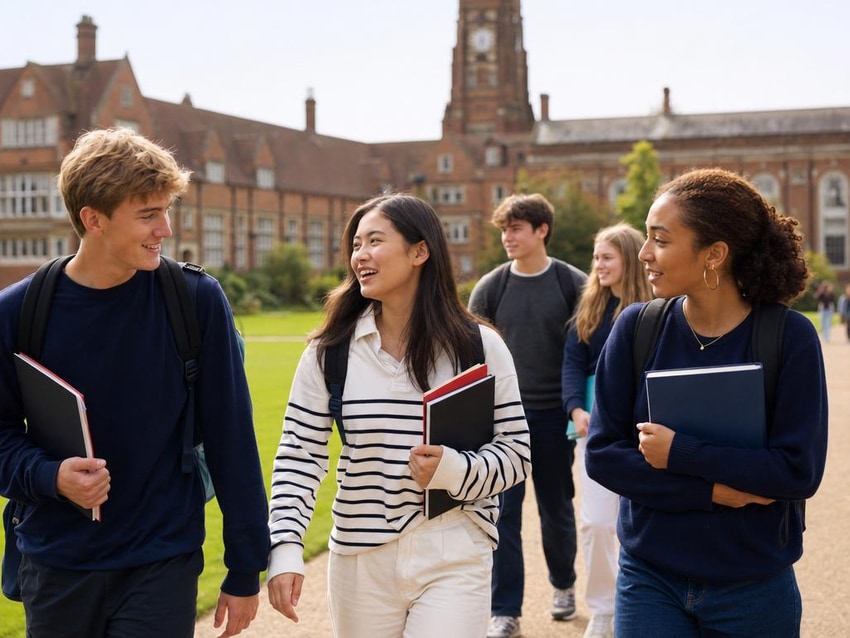
The British curriculum divides secondary education into two distinct stages, each with a different role in the academic journey. GCSEs in Years 9 to 11, for students aged 14 to 16, establish the foundation across up to ten subjects. A-Levels in Years 12 and 13, from ages 16 to 18, develop three or four subjects to a degree of specialisation that university admissions officers worldwide recognise as a genuine sign of academic readiness.
For international students, this system opens two entry windows with completely different profiles. Those who enter at GCSE level have two years to build academic English vocabulary and adapt to the British pace before sitting the certifications. Those who enter directly into A-Levels need to arrive with solid English and already know which direction they want to take at university. Choosing the wrong window has practical consequences, and the right choice depends on the student's background, not the parents' preferences.
What GCSEs and A-Levels actually are
The British secondary curriculum has two stages with different functions:
- GCSEs (Years 9-11, ages 14-16): certification at the end of Key Stage 4. Students choose between eight and ten subjects, with English, Mathematics, and Sciences as compulsory. Assessment combines written examinations with practical work. Grades run from 9 (highest) to 1, a system introduced in 2017.
- A-Levels (Years 12-13, ages 16-18): a two-year programme focused on three to four subjects studied in depth. Grades run from A* to E. An A grade in each of three subjects can represent 144 UCAS points, according to the official UCAS tariff.
The secondary education system in England is structured by year with fixed and elective subjects, and the difference between boarding and day school directly influences how quickly a student settles in.
Boarding school vs day school: the real difference
The difference between the two models goes well beyond accommodation arrangements.
Boarding school means the student lives on the school campus during term time, with residential supervision, meals included, continuous access to laboratories, sports facilities, and libraries, and a structured routine outside lesson hours. The level of English immersion is total, and daily contact with peers from 40 to 60 different nationalities is a core part of the educational design, not a secondary benefit.
Day school is the format in which the student attends classes but sleeps in external accommodation, usually a host family arranged by the school or the consultancy. The running cost is lower, but the level of linguistic immersion depends heavily on the quality of the family and the neighbourhood where the student lives.
The British secondary model at Bournemouth Collegiate School illustrates the combination well: GCSEs and A-Levels on a campus with reference sports facilities and full residential support for international students.
How international students enrol
The enrolment process at a British independent school involves three main stages:
- Application with academic records: the school reviews grades from the past two years, a motivation letter, and, in many cases, teacher references.
- English test or interview: most independent schools require the equivalent of IELTS 5.0 for entry into GCSEs (Year 10) and IELTS 5.5 to 6.0 for the Sixth Form (A-Levels). Some use the UKiset, which assesses verbal, numerical, and logical reasoning in English.
- Child Student visa: required for students aged 4 to 17 without a British passport or settled status in the UK. The visa is issued on the basis of the school's unconditional offer letter, and the school must be registered with UK Visas and Immigration. Processing takes approximately three weeks, according to GOV.UK.
The most common entry windows are September (start of the British academic year) and January (start of the second term). Some boarding schools accept April entry, in the third term, but that is the least common option and limits integration.
The Aldenham School in England is a concrete example of how the application process works at a boarding school with a long academic tradition in Hertfordshire.
Independent schools in England: what sets the private sector apart
The British state education system does not accept students holding a Child Student visa. Every international student studies in the independent (private) sector.
This sector is inspected by the ISI or Ofsted, with results published publicly. Boarding schools are accredited by the Boarding Schools Association (BSA), which audits safeguarding, health, and student wellbeing. Within the independent sector, there are different profiles:
- Schools focused on British university entry: prepare students specifically for UCAS, with a track record of Oxbridge and Russell Group admissions.
- Schools with an international profile: have cohorts with a majority of non-British students, more structured EAL (English as an Additional Language) support, and a curriculum that includes the IB Diploma as an alternative to A-Levels.
- Schools focused on arts or sport: combine academic excellence with a specialised programme in one area, resulting in a weekly schedule of 30 to 35 hours between lessons and activities.
The top 4 boarding schools for studying arts in England are all in the independent sector and combine artistic training with a rigorous academic curriculum at the same institution.
Be Easy's British boarding school partners
The schools below are direct Be Easy partners in England, all offering GCSEs and A-Levels for international students. Each school has a distinct profile:
- Aldenham School (Hertfordshire): focus on co-curricular curriculum and nationality diversity.
- Queens College (Somerset): focus on Oxbridge and Russell Group admissions.
- Bournemouth Collegiate School (south coast): focus on high-performance sport combined with academic training.
Aldenham School
A school in Hertfordshire, north of London. Offers GCSEs from Year 9 and A-Levels in the Sixth Form. The boarding programme accommodates students from over 40 nationalities. The differentiator is the structured co-curricular curriculum: orchestra, drama, team sport, and leadership programmes with defined hours, not sparse optional activities.
Queens College
Located in Taunton, Somerset, with a focus on university admission. Teaching at Queens College includes UCAS guidance and personal statement support from Year 12, with preparation for Oxbridge interviews.
Bournemouth Collegiate School
On England's south coast. Offers GCSEs, A-Levels, and a Foundation Programme. Bournemouth Collegiate on the English coast includes partnerships with professional clubs for students with an athletic vocation.
- Secondary education in England focused on university admissions follows a well-defined path: UCAS, personal statement, and Oxbridge interview preparation worked on from Year 12.
- The curated high school abroad programme brings together school profiles, age ranges, and formats, with support from application through to arrival.
Frequently asked questions about high school in England
Are GCSEs compulsory for international students who want to do A-Levels?
Not necessarily. Students with a strong academic background and advanced English can enter the Sixth Form (Year 12) directly without sitting GCSEs. The decision depends on the school's individual assessment, which looks at previous grades, an English test, and, in some cases, an interview. Most boarding schools accept direct entry into Year 12 for students who have turned 16.
What level of English is required to enter a British independent school?
For GCSEs (Year 10), most independent schools accept the equivalent of IELTS 5.0. For A-Levels (Year 12), the expectation is IELTS 5.5 to 6.0. Schools with structured EAL support may accept slightly lower levels, on the condition that the student attends English support classes in the first year.
What is the Child Student visa and how long does it take to be issued?
The Child Student visa is required for students aged 4 to 17 who are going to study at independent schools in the UK. The school must be registered with UK Visas and Immigration. Processing takes approximately three weeks, according to GOV.UK. The visa is issued in stages: one for the GCSE period and another for the A-Level period.
From what age do boarding schools in England accept students?
Most British boarding schools accept international students from age 13 (Year 9), the most common entry point before GCSEs. Some schools accept younger students from age 11 (Year 7), but these are a minority and generally require a legal guardian resident in the UK.
Do A-Levels give access to universities outside the United Kingdom?
Yes. A-Levels are recognised by universities in the United States, Canada, Australia, and most European countries. In the US, strong A-Level grades can result in advanced credits at many universities. In Canada and Australia, A-Levels meet the admission requirements of leading public universities. The IB Diploma, offered by some boarding schools as an alternative, has an even more standardised recognition internationally.
Be Easy: boutique international exchange consultancy
Be Easy supports families who want their child to build a solid academic track record before university. Whether the plan is one or two years of A-Levels in England, or starting with GCSEs for more adaptation time, we have the right curated selection to identify the school that best fits the student's profile. To explore the options available and speak with a dedicated senior consultant, get in touch with us.

