
Aerospace Engineering: The Profession of the Future and How Your Child Can Start Before College
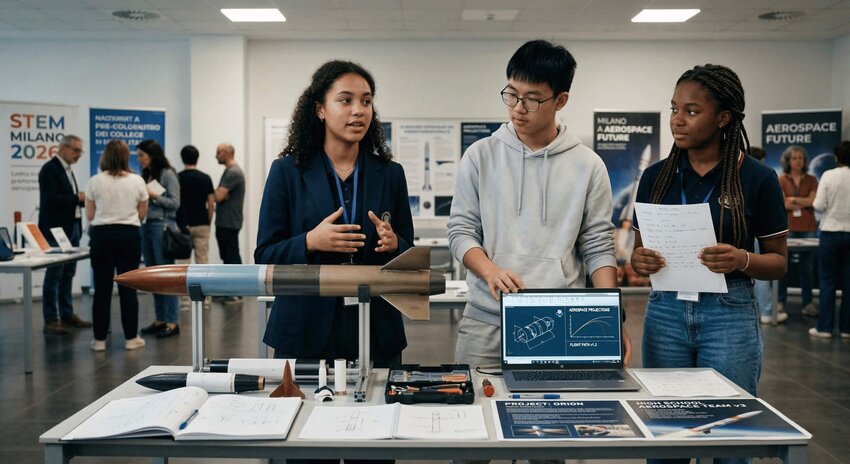
Aerospace engineering is among the careers with the greatest growth prospects in the coming decades. Communication satellites, reusable launch vehicles, lunar missions, and autonomous defense systems: the sector is expanding at a rapid pace, and the demand for qualified professionals is still not keeping up with this growth.
For parents of young people who already show an interest in space, rockets, or technology, this reading provides concrete data about the market and shows how it is possible to build the foundations of this career long before college, with structured international programs that bring young people in contact with the real sector.
Why is aerospace engineering considered the profession of the future?
The aerospace sector has undergone a significant transformation over the past two decades. What was once exclusively dominated by government agencies such as NASA, ESA, and national agencies today includes hundreds of private companies that compete for contracts, talent, and markets.
This new space economy, often referred to as “New Space”, includes launch companies, satellite manufacturers, propulsion system developers, and geospatial data providers for sectors such as agriculture, logistics, and telecommunications. The direct result of this growth is an expanding labor market, with vacancies that still do not find sufficiently qualified candidates to fill them.
According to data from ESA and industry reports, the global aerospace market generates more than 400 billion dollars a year, with consistent growth projections through 2035. This number represents not only space missions, but the entire value chain that underpins the industry: materials, embedded electronics, communication systems, simulation software, and orbital logistics.
For a young person who is 15, 16 or 17 years old today, the scenario at graduation will be even more favorable than the current one.
What areas of expertise exist within aerospace engineering?
One of the biggest misconceptions about this career is to think that it boils down to “working with rockets”. In practice, aerospace engineering encompasses a wide range of specialties, many of which have direct applications outside the space sector.
The main lines of action include:
- Propulsion and launch systems: development of engines, fuels, and control systems for rockets and launch vehicles
- Aerodynamics and flight dynamics: modeling the behavior of aircraft and rockets under different atmospheric conditions
- Embedded systems and electronics: development of hardware and software for mission control, telemetry and navigation
- Satellite engineering: design, construction, and operation of satellites for communication, Earth observation, and science
- Space robotics: unmanned vehicles, rovers, and autonomous systems for exploration
- Materials and structures: development of lightweight alloys, composite materials and structures resistant to extreme space conditions
Each of these specialties is in demand both in traditional aerospace companies such as Airbus, Boeing, Leonardo S.p.A. and Embraer, and in startups in the New Space sector that emerge every year. And most of the basic skills, such as programming, electronics, and applied physics, also open doors in sectors such as defense, electric mobility, and cutting-edge technology.
Is the aerospace market hiring? What are employers looking for?
The answer is yes, and the shortage of qualified professionals is a real problem for companies in the sector.
The profile most contested by companies such as Leonardo S.p.a., Airbus and ESA combines three elements that few universities are able to develop in an integrated manner:
- Strong technical base: physics, mathematics, and programming at an applied level, not just a theoretical one
- Documented practical experience: concrete projects, prototypes developed, measurable results
- International training: fluency in English, history of working in multicultural teams, ability to operate in high-demand environments
The third point is where many candidates are left behind. The largest companies in the sector operate on a global scale, with teams distributed in different countries. An engineer who graduates without any international experience starts from a disadvantaged position in contested selection processes.
Why does starting before college make a difference in an aerospace career?
Aerospace engineering has a well-known bottleneck among those who work with university selection: most candidates go to college without ever having real contact with the area. The first years of graduation are almost exclusively theoretical, and many students only have their first practical experience years after starting the course.
Those who arrive with previous practical experience start from a different level.
It's not just about a resume. It's about vocational clarity, about concrete references, about knowing what happens inside a propulsion laboratory before choosing an elective subject. Young people who undergo technical programs before university enter graduation with more mature questions, learn faster and build networks earlier.
For the selection processes of the best engineering universities abroad, this pre-university background has direct weight. Institutions in Europe and North America evaluate candidate portfolios that include technical training certificates, documented practical projects, and international experiences. A 17-year-old with that track record competes at another level.
How does the Sapienza aerospace engineering program for young people work?
Be Easy offers access to Aerospace Engineering & Space Technologies Program, carried out at the Aerospace Engineering School of the Sapienza University of Rome. Founded in 1926 and celebrating 100 years of innovation in 2026, the school is one of the European references in aerospace training and research. The program is developed in partnership with the Italian Space Agency (ASI) and the European Space Agency (ESA).
The format is residential, with a duration of two weeks and 30 intensive hours of classes and laboratories. The next class will take place from July 19 to August 1, 2026, in Rome, Italy. The program is aimed at young people aged 15 to 18 with English starting at level B1.
What participants develop over the two weeks:
- Foundations of propulsion and rocket physics, with a practical approach from day one
- Simulation of space missions and development of embedded systems with Arduino
- Construction of a real rocket prototype using OpenRocket software
- Effective launch of the rocket in Rovigo, as a project to conclude the program
- Visit to an industry-leading aerospace company
Prior knowledge in engineering, programming, or advanced physics is not required. The curriculum begins with the fundamentals and progresses progressively. The only real requirement is genuine interest in the area.
What is included in the residential program?
The residential regime covers all aspects of the stay during the two weeks, without the family having to worry about logistics during the program.
Included:
- Accommodation in a university residence in the center of Rome, in a single room with private bathroom
- Full board: breakfast, lunch and dinner (full board)
- 24-hour supervision and insurance throughout the period
- All technical modules, laboratories, and program materials
- Visit the leading aerospace company in the sector
- Real rocket launch in Rovigo
- Rome Cultural Tour: Colosseum, Pantheon, and Trevi Fountain (July 25)
- Certificate of completion issued by the School of Aerospace Engineering at Sapienza University of Rome
The certificate has a concrete weight in international university applications. It associates the young man's name with one of the most recognized aerospace engineering schools in Europe and documents the completion of a technical program with a real practical project.
Do young people need to know English to participate?
The program is taught in English, with participants from different countries. The formal requirement is level B1 (intermediate).
In practice, living together in an environment where English is the language of everyday communication represents a real advance for those at a basic or intermediate level. Two weeks of total immersion in English, with young people of other nationalities, in and out of class, have an effect on language development that is difficult to achieve in a conventional course.
For young people who are still developing English, the program serves both as technical training and as a fluency accelerator. Both objectives happen at the same time.
FAQ: frequently asked questions about aerospace engineering as a profession of the future
Is aerospace engineering good for employment in today's market?Yes. The sector is expanding globally and the demand for qualified engineers exceeds the supply of trained professionals. Companies such as Airbus, Leonardo S.p.a., ESA, and dozens of startups in the New Space sector are actively hiring and are facing talent shortages with a combination of solid technical base and practical experience.
Does my child need to be excellent at math to pursue this career?A solid foundation in mathematics and physics is important, but the profile required by the market goes far beyond grades. Ability to work as a team, practical problem solving, experience with electronic systems and programming, and international experience are skills equally valued by employers in the sector.
At what age does it make sense to start building this path?The sooner, the better. Young people aged 15 to 18 who participate in international technical programs arrive at university with vocational clarity and concrete differentials. Engineering universities abroad evaluate pre-university history with real weight in the selection processes.
Is the Sapienza program suitable for young people who have not yet decided on a career?Yes. One of the core functions of the program is exactly that: to give young people real contact with aerospace engineering before making long-term decisions. Many participants arrive with a general interest in technology and are clear about the path they want to follow, or don't want to, which is also valuable information.
How does Be Easy support the family during the enrollment process and during the program period?Be Easy takes care of all documentation, visa guidelines and logistics so that the family arrives at the shipment with everything resolved. During the program, the team maintains an open channel with the parents, and the residence has 24-hour on-site support for the young person.
Be Easy
At Be Easy, we connect families to international programs that have a real impact on the trajectory of young people. The Aerospace Engineering & Space Technologies Program at Sapienza University of Rome is one of those programs: structured, technical and with concrete results. If you want to understand if it's the right choice for your child's profile, contact us.

