
Aerospace engineering summer camp in Rome: a complete guide for young people aged 15 to 18
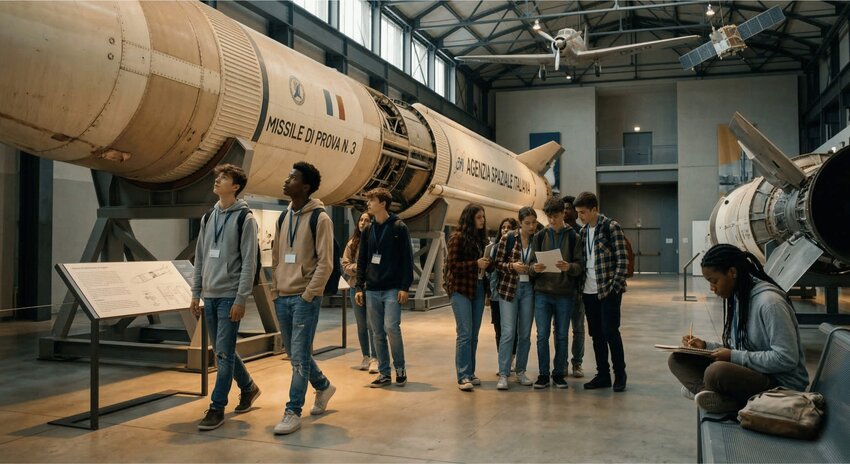
O aerospace engineering summer camp in Rome is one of the most comprehensive programs available in Europe for young people aged 15 to 18. Two weeks at the Aerospace Engineering School of Sapienza University of Rome, in partnership with Agenzia Spaziale Italiana (ASI) and Agenzia Spaziale Europea (ESA): real technical laboratories, rocket construction and launch in Rovigo, visit to a leading and certified aerospace company with international curricular weight. All this in one of the richest cities in the world in history and culture.
In this guide, you will find everything you need to know to safely evaluate the program: the technical modules, the accommodation structure, what the certificate represents in university selection processes, the profile of the ideal young person, and how the enrollment process works with Be Easy.
What is the Aerospace Engineering & Space Technologies Program?
O Aerospace Engineering & Space Technologies Program It is a residential technical immersion designed for young people aged 15 to 18 with an interest in engineering, space and technology. The program takes place in Rome, Italy, based academically at the School of Aerospace Engineering at Sapienza University of Rome.
Sapienza was founded in 1303 and is one of the oldest universities in the world still in operation. Its Aerospace Engineering School, founded in 1926, celebrates 100 years of innovation in 2026 and has trained generations of engineers that today work at ASI, ESA and the largest companies in the sector. The program is developed in formal partnership with these two space agencies, which gives the curriculum an institutional character that goes far beyond a common technical course.
The program lasts 2 weeks, with 30 intensive hours of classes and laboratories, on a residential basis. The daily coexistence with young people from different countries is a structural part of the formation.
Essential data of the program:
- Dates (2026): July 19 to August 1
- Duration: 2 weeks | 30 hours of intensive classes and laboratories
- Location: Rome, Italy — Sapienza University School of Aerospace Engineering
- Audience: young people from 15 to 18 years old
- Language of instruction: English (minimum level B1)
- Prior technical knowledge: not required
- Institutional partnership: ASI (Italian Space Agency) and ESA (European Space Agency)
- Certificate: issued by the Sapienza School of Aerospace Engineering
What are the summer camp modules?
The program is structured in seven progressive technical modules. The logic of progression is important: the young person begins with conceptual foundations, moves on to computer simulations, and ends the program with the construction and actual launch of a rocket.
Rocket Engineering & Propulsion
The first module presents the physical principles that govern rocket flight: thrust, specific impulse, Tsiolkovsky equation. Participants learn how NASA and ESA engineers calculate the variables of a real mission, before applying these concepts to the following modules.
It is not necessary to have a background in advanced physics. The instructors start from scratch and build their reasoning progressively, with practical examples of real missions.
Aerodynamics & Flight Dynamics
This module covers the fundamentals of aerodynamics applied to the flight of rockets and aircraft. Participants study drag, lift, flight stability, and how these factors influence aerospace vehicle design.
Space Mission Design & Simulation
Here the focus shifts to space mission planning. Participants learn the structure of a real mission, from defining objectives to simulating trajectories and managing engineering constraints.
Embedded Systems & Electronics (Arduino)
One of the most practical modules in the program. Participants learn how to program Arduino microcontrollers to control embedded systems, the same type of technology used in satellites and rockets for real-time monitoring and control.
Aerospace Systems Engineering
This module presents the discipline of systems engineering applied to the aerospace sector: how to integrate different components into a functional system, ensuring that each part fulfills its function within a coherent whole.
Rocket Prototype Development & Launch
The most awaited module in the program. In teams, participants design, build, and test a real rocket prototype, using the software OpenRocket to simulate the trajectory before launch. The project culminates in the effective launch of the rocket in Rovigo.
Design Foundations & Sketching
The last module complements technical training with fundamentals of aerospace design: how to communicate visual ideas, represent components and structures, and think about the creative process within engineering.
How does a visit to the real aerospace company work?
One of the most impactful activities of the program is the industrial visit to a real aerospace company, with Leonardo S.p.a. as the program's central reference.
Leonardo S.p.A. is one of the largest aerospace, defense and security technology companies in the world. It operates in more than 150 countries and develops satellites, helicopters, navigation systems, embedded electronics and technology for space missions.
Where are the participants staying?
The accommodation is in a university residence in Rome, structured specifically for the program's residential regime.
What is included in the accommodation:
- Single rooms with private bathroom
- Kitchenette available in the room
- Equipped gym
- playroom
- filmmaking
- Terraces
- Laundry
- House parents available at night
What is the weight of the certificate in the international curriculum?
The certificate is issued by Sapienza University of Rome Aerospace Engineering School, an institution with more than 700 years of academic history and a consolidated presence in the European aerospace ecosystem.
What is the ideal young person's profile for this program?
The program does not require prior technical knowledge in engineering, physics, or programming.
The young person who enjoys the program the most often has:
- Genuine curiosity about science, technology, space, or engineering
- Willingness to work as a team and solve practical problems
- Interest in having contact with the international academic and professional environment
- English at least level B1 (intermediate)
- Between 15 and 18 years old
FAQ: frequently asked questions about the summer camp
Do young people need to have a minimum level of English to participate?Yes. The program requires English at level B1 (intermediate) or above.
Do you have support for parents during the program?Yes. Be Easy maintains an open communication channel with families throughout the summer camp period.
Is the certificate valid for university admission processes outside Brazil?Yes. The certificate is issued by the School of Aerospace Engineering at Sapienza University of Rome, an internationally recognized institution.
Is the program suitable for young people who haven't decided on a career yet?Yes. One of the most important functions of the program is precisely this: giving young people real contact with the area before making long-term decisions.
What is the selection process for entering the program?The process is carried out in order of registration and profile analysis, without a technical selection exam.
Be Easy
Be Easy has more than 200 partnerships with international institutions and accompanies families at all stages of the exchange process. For the Aerospace Engineering & Space Technologies Program, our team guides the family from profile assessment to the return of the young person. If you want to understand if this program is the right choice for your child, contact us.

