
Aerospace Engineering Summer Camp in Europe 2026: Programmes and Profiles
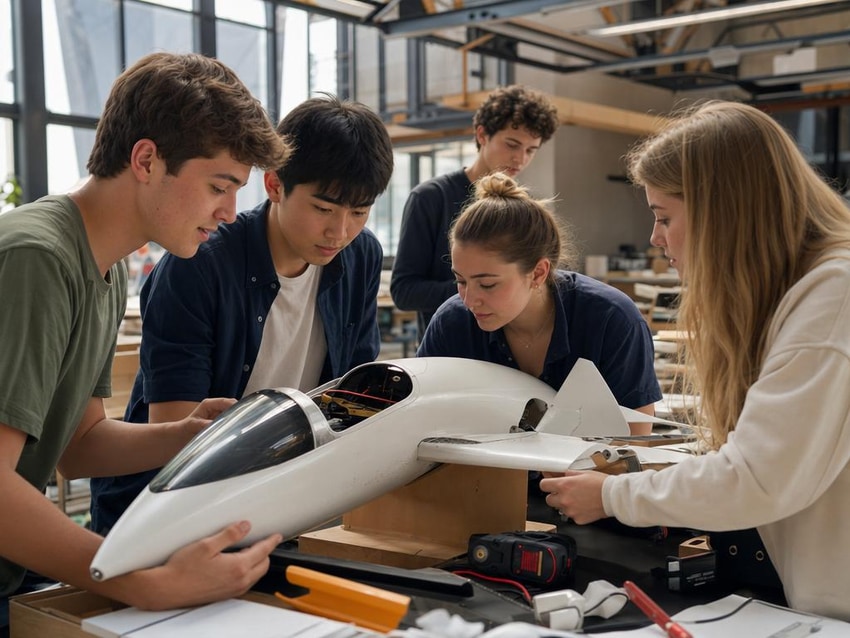
The Sapienza School of Aerospace Engineering celebrates 100 years of history in 2026 and has trained generations of engineers who now work at the Italian Space Agency and the European Space Agency. This is the environment where the aerospace exchange programme in Europe for young people aged 15 to 18 takes place in summer. It is part of the vocational careers curation for young people, with 30 hours of classes and practical laboratories over two weeks.
The proposition is distinct from an online course or a school visit. The student builds and launches a rocket prototype. Uses OpenRocket to model trajectories. Programs embedded systems with Arduino to collect flight data. These are not abstract simulations — they are the real tools used by engineers designing space missions.
What does the student learn at the aerospace engineering summer camp in Europe?
The curriculum is organised in three progressive modules. Each one supports the next, so the young person arrives at the third already with the foundation needed to apply the content in practice.
- Module 1, Rocket Engineering and Propulsion: fundamentals of how rockets work, how propulsion systems are designed, and how aerospace engineers plan space missions.
- Module 2, Mission Simulation and Embedded Systems: use of OpenRocket to model trajectories and understand flight dynamics; development of Arduino systems to control rocket electronics and collect telemetry data.
- Module 3, Prototype Development and Launch: students design and build their own rocket, culminating in the launch in Rovigo.
The English requirement is B1+. All classes are in English, meaning the young person reinforces the language while absorbing engineering.
- Rocket prototype designed and built by the group by the end of the two weeks
- Telemetry data collected by the Arduino system developed during the programme
- Completion certificate issued by the Sapienza documenting the technical content
The programme serves young people aged 15 to 18, with no requirement for advanced physics.
What is the daily routine like in the Rome programme?
Arrival is on Sunday 19 July for the 2026 residential edition. Departure is on Saturday 1 August.
- 7:30 am: wake up
- 8:30 to 12:45: two classes with a break
- 13:45 to 16:30: two laboratory blocks
- 5:00 to 7:00 pm: excursions or cultural activities
- 8:00 to 10:30 pm: supervised group evening activities
The calendar includes a visit to a leading aerospace company and tours of Rome's historic monuments. The cultural context is part of the immersion, not an extra.
- Accommodation in a university residence in the city centre, individual studio rooms with private bathroom
- Gym, cinema room, terraces, and study spaces
- House parents supervising at night
There is also a day programme option for those based in Rome or who prefer independent accommodation during this period.
Who benefits most from this type of programme?
O aerospace engineering exchange programme for young people makes the most sense for four specific profiles:
- The student who already knows they want engineering but does not know which field: physics, electronics, programming, and mechanical design appear integrated in the same programme. It is a good vocational filter before choosing a degree.
- The young person interested in aviation or space who has never had access to a real laboratory: the difference between reading about propulsion and assembling an embedded system that will collect flight data is significant for vocational clarity.
- The student who wants to strengthen their international profile before university admissions: a Sapienza certificate documents participation in a leading European academic environment.
- The young person developing English fluency: the programme functions as a technical language intensive, because all engineering terminology is absorbed in English.
O aerospace engineering summer camp uses Arduino to collect real flight data, from the assembly phase to launch telemetry.
What sets the Sapienza-based programme apart from other engineering camps?
Three concrete factors separate this format from generic STEM programmes.
Centenary institution with active connection to space agencies
The Sapienza School of Aerospace Engineering was founded in 1926. It has trained engineers who now work at the ASI (Italian Space Agency) and ESA (European Space Agency). The student is not in just any classroom in Rome — they are in the ecosystem where Italian aerospace engineering was built.
Real prototype with verifiable launch
O rocket launch at the aerospace summer camp for young people is the programme's concrete output. The launch takes place in Rovigo, with data collected by the embedded systems the group itself developed during the week. Each team leaves the programme with real telemetry records, not a theoretical report.
Professional tools from the start
OpenRocket is the standard software for academic rocket modelling. Arduino is the prototyping platform used in university satellite projects around the world. The use of Arduino and OpenRocket in the Rome aerospace programme is standardised in real academic contexts, not simplified for young people.
Does the Sapienza certificate carry weight in university admissions?
Yes. The certificate attests to participation in an academic programme in English at a European university founded a century ago, with verifiable technical content.
- Documents exposure to real engineering before university
- Demonstrates familiarity with international academic environment
- Differentiates the profile in selection processes that consider extracurriculars
O Sapienza certificate in the CV before the age of 18 carries weight for candidates who want engineering abroad. It does not replace academic performance, but complements the profile of those who gained early exposure.
Why Rome as a destination for an aerospace engineering summer camp in Europe?
Rome is not the obvious choice for engineering. The logic is functional: the Sapienza is there, with a laboratory and faculty directly connected to national and European space agencies.
- Equipment and laboratories used in active aerospace research
- Faculty with connections to ASI (Italian Space Agency) and ESA (European Space Agency)
- Excursions to historic monuments integrated into the official calendar
The programme takes place in a real academic environment, not a temporary facility set up for summer courses. The practical difference is that the equipment, protocols, and institutional context are the same as those used in the school's regular research.
A career in aerospace engineering is built through early exposure to an institutional laboratory, not through generic simulations.
Perguntas frequentes sobre o aerospace engineering summer camp na Sapienza
Do I need a programming background to join the programme?
It is not a prerequisite, but some familiarity with programming logic helps in the embedded systems module with Arduino. The programme starts from basics and advances progressively over the two weeks. Young people who have never used Arduino before can complete the modules without structural difficulty, as long as they have adequate English to follow the technical instructions.
What level of English is required?
B1+ is the official requirement. Classes, laboratories, and all academic communication are conducted in English. Young people below B1 level will struggle to follow the technical content.
Is the programme only for young people who want to pursue aerospace engineering?
Not necessarily. The curriculum covers applied physics, programming, mechanical design, and data analysis. Students interested in mechanical engineering, electronics, or computer science will find equally relevant content.
How does supervision work during the residential programme?
The university residence has house parents overnight. The programme staff accompanies academic activities, laboratories, and excursions with 24-hour supervision and insurance included.
Is the residential or day programme format more worthwhile?
It depends on the profile and family logistics. The residential format offers full immersion: living with international peers, evening activities, and autonomous routine management. The day programme works for those based in Rome or who prefer greater flexibility. The engineering exchange programme for teenagers raises objective questions about format, cost-benefit, and profile suitability before the final decision.
Be Easy: Boutique International Education Consultancy
Be Easy supports families who want to give their child a genuine advantage before university. If your child has an interest in aerospace, engineering, or sciences, we have the right curation for them to build that path in the appropriate environment. To explore the vocational careers exchange programme for young people and speak with a dedicated senior consultant, get in touch with us.

