
Aerospace Engineering Exchange: The Complete Guide for Young People

Some young people know from an early age that they want to work with rockets, satellites or space exploration. The challenge is that most of the available paths start only at the university, with years of theory before any contact with the real area.
In this guide, you will learn about a different path: a aerospace engineering exchange two-week residential in Rome, with real laboratories, rocket launches and access to companies such as Leonardo S.p.a., Pagani Automobili and Italdesign. We will detail the program, the technical modules, what is included, the dates for Summer 2026, and how to guarantee the vacancy.
What is the Aerospace Engineering Exchange Program?
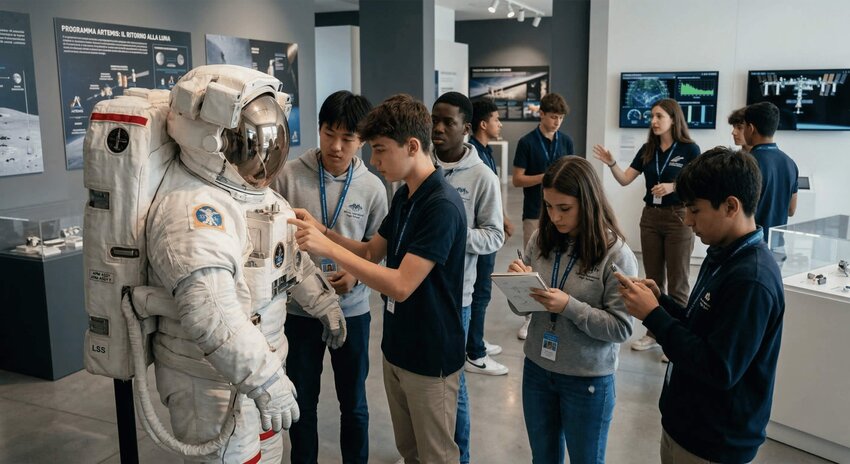
The program is a residential technical immersion designed for young people aged 15 to 18 with an interest in engineering, space, and technology. It takes place in Rome, Italy, with an academic base in Sapienza University of Rome Aerospace Engineering School, one of the oldest and most recognized aerospace institutions in Europe, founded in 1303.
During two intense weeks, participants go through three technical modules, develop a rocket prototype, carry out the actual launch, and visit some of the most innovative companies in the European aerospace and automotive sector.
The format is exclusively residential. This means lodging on site, meals included, and daily interaction with young people from other countries, which transforms technical learning into a much broader training.
Program summary:
- Duration: 2 weeks on a residential basis
- Venue: Rome, Italy, Sapienza University of Rome
- Age range: 15 to 18 years
- Language: English (all levels accepted)
- Certificate of completion included
- Next class: Summer 2026, July 19 to August 1
Why Rome and Sapienza University of Rome?
When it comes to aerospace engineering, the United States is often the first reference. But Europe has a consolidated tradition in the sector that places countries such as Italy, Germany and France among the global leaders in the area.
A Sapienza University of Rome It is the largest university in Italy and one of the largest in Europe, with over 700 years of existence. Its Aerospace Engineering School is a reference in research and in the training of engineers who today work in space agencies, defense companies, and innovation centers around the world.
Studying in this environment means more than having access to well-equipped laboratories. It means being in an ecosystem where aerospace engineering has been taken seriously for decades, and where young participants are treated as future professionals in the sector.
In addition to the academic structure, Rome offers a cultural experience that makes the exchange a complete formation. The participants live in one of the most historic capitals in the world, which enriches the period far beyond laboratory hours.
For parents: the program operates on a residential basis with 24-hour support, dedicated staff and the entire logistical structure organized so that young people can focus on learning. Be Easy, with more than 200 international educational partnerships, takes care of every step of the process, from planning to arrival.
What are the technical modules of the program?
The program is structured in three modules that are built progressively: from the theoretical foundation to the actual launch of a rocket. Each module was designed so that the participant leaves with applicable practical skills, not just with memorized concepts.
Module 1: Rocket Engineering & Propulsion
The starting point is to understand how a rocket actually works.
In this module, young people develop a solid foundation in rocket engineering, exploring the physical principles that allow a vehicle to generate enough thrust to break through the atmosphere. Topics covered include propulsion, flight physics, applied aerodynamics, and the different engine systems used in the real industry.
The approach is carried out in the laboratory, with exercises that connect theory to practical application. By completing this module, the participant already understands what happens behind the scenes of a space launch, and why each engineering decision has direct consequences on vehicle performance.
Module 2: space mission simulation & embedded systems (Arduino)
If the first module teaches how the rocket works, the second puts the young person in the role of the person who plans and controls the mission.
Here, participants use spatial trajectory simulation tools to model the behavior of rockets under different conditions. The module differential is the part of embedded systems with Arduino: young people develop electronic circuits to control rocket systems, including telemetry, the transmission of data in real time during the flight.
At the end of this module, the participant knows:
- Program Arduino systems for practical aerospace applications
- Develop embedded sensors and control systems
- Model rocket trajectories with simulation software
- Integrate electronics, software, and mechanical engineering into a project
This combination of competencies is exactly the profile that the world's aerospace companies are looking for today.
Module 3: rocket prototype development & launch
This is the module that everyone is waiting for: the development and actual launch of a rocket.
Participants work in teams to design, build, and test a prototype rocket, applying everything they learned in the previous modules into practice. The process follows real engineering phases:
- Conception and design
- Construction of the prototype in the laboratory
- Technical tests and adjustments
- Actual release
The launch is not simulated. The rocket built by the participants themselves is effectively launched. It is one of the most concrete experiences a young engineer can have before entering university.
In addition to the rocket, each participant also creates a clay model, an activity that develops the ability to transform engineering concepts into physical form, widely used in the development of aircraft and vehicles in the real industry.
What companies do the participants visit?
One of the program's biggest differentials is its access to organizations that rarely open their doors to young students. The visits are part of the official schedule and bring participants into direct contact with the aerospace and advanced engineering market.
Leonardo S.p.a.
Leonardo is one of the largest aerospace, defense and security technology companies in the world, with a presence in more than 150 countries. It develops technologies ranging from military helicopters to satellites, air navigation systems and embedded electronics.
The visit brings young people into contact with engineers who work every day with the same problems discussed in the program modules. It's an opportunity to ask real questions to real professionals, and to understand, up close, what a career in the aerospace sector is like.
Pagani Automobili
Pagani is recognized worldwide for the production of hypercars that combine advanced materials engineering, aerodynamics and performance at a level that few companies in the world can replicate.
The visit is not about cars. It's about materials engineering, applied aerodynamics and the mentality of seeking technical excellence in every detail of a project. These principles are the same as those that underpin aerospace engineering, and seeing this applied so tangibly to a physical product is one of the most striking moments of the program for the participants.
Italdesign & Museum
Italdesign is one of the most influential industrial design and engineering studios in the history of motorsport and mobility. Founded by Giorgetto Giugiaro, it was responsible for projects that defined generations of vehicles around the world.
The visit connects participants to the process of transforming engineering concepts into real products: from the idea to the prototype, through integrated design. For those thinking about a career in engineering, understanding this process is essential. Visiting the Italdesign museum is a lesson in the history of applied engineering.
What is included in the residential program?
The program operates exclusively in residential regime: the participants live on site for two weeks, which creates a total immersion: technical, cultural and human.
Networking takes place over dinner. Ideas come up in the conversation after school. Friendships with young people from other countries are built on a daily basis. This environment is an intentional part of the program proposal.
What's included:
- Accommodation for 13 nights (Sunday to Saturday)
- 3 meals a day
- Insurance for the entire period
- Staff support 24 hours a day, 7 days a week
- All classes, laboratories, and practical activities for the three modules
- Visits to Leonardo S.p.a., Pagani Automobili and Italdesign & Museum
- Rocket Launch Experience (actual prototype launch)
- Creation of a clay model
- Certificate of completion issued by the program
The certificate represents participation in a high-level engineering program, based at the facilities of the School of Aerospace Engineering at Sapienza University of Rome. It has real weight in curricula for universities and international selection processes.
Who is this program for?
The program was developed for young people aged 15 to 18 with an interest in engineering, science, technology, or space. It does not require any previous technical knowledge.
It is not necessary to have studied advanced physics. You don't need to know how to program. Prior experience with electronics or embedded systems is not required. The program starts with the fundamentals and progresses progressively over the two weeks. The only real requirement is curiosity and a real desire to learn from the topic.
The program language is English, but participants at all levels are accepted. For those with basic or intermediate English, immersion in an environment where the language is used naturally and constantly is, in and of itself, a significant advance.
This program is suitable if the young person:
- Are you interested in engineering, physics, programming, or space exploration
- Do you want to explore a technical area before defining a career at the university?
- Are you looking for an international experience that is different from a conventional language exchange?
- Do you want to build an international portfolio and resume that stands out in selections?
- He is between 15 and 18 years old and is willing to challenge himself for two weeks in a real environment
For parents who accompany young people in the career decision phase: this program offers the chance for the child to test a highly technical area under real conditions, with full support, before any long-term academic commitment. It's career planning with practical experience, not theory.
What is the difference between this program and a conventional language exchange?
The question is pertinent, and the answer matters to those who are considering how to invest young people's time during the summer.
A conventional language exchange focuses on language fluency. It's valuable, but technical development is in the background. This aerospace engineering program has different objectives:
- Practical technical training: participants learn engineering, electronics, and programming applied to real projects
- Concrete portfolio: In the end, the young man has a rocket launched, developed systems and a certificate from a European university
- Access to the industry: Visits to Leonardo, Pagani and Italdesign are experiences that don't exist in conventional programs
- Career clarity: many young people leave the program with a much clearer understanding of what they want, or don't want, for their careers
The language continues to be developed, since the program is taught in English and the coexistence is international. But the central focus is on engineering training.
If young people are thinking of pursuing a technical career, this program has a formative return that goes far beyond what a conventional language exchange can offer during the same period.
Why can an aerospace engineering exchange change a young person's trajectory?
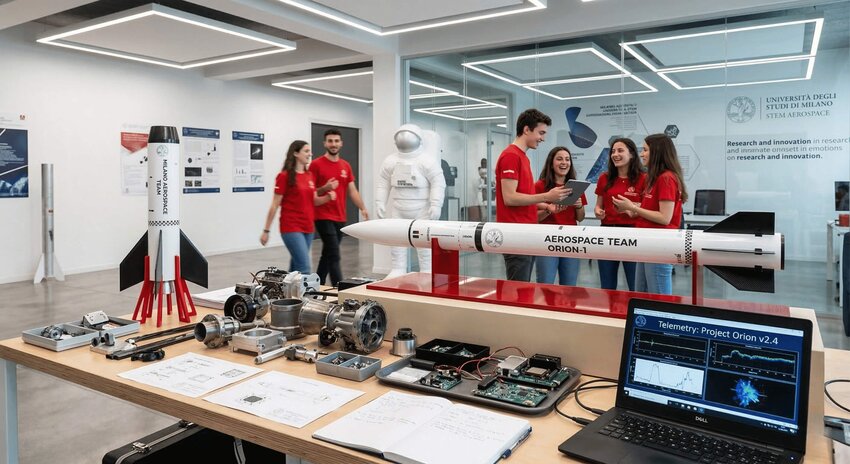
Aerospace engineering has a known entry problem: most young people who enter courses arrive at college without ever having real contact with the area. Learning starts from scratch, in a purely theoretical way, and many only have their first practical experience years after graduation.
Those who go through a program like this arrive at the university in a different position:
- Have you ever built and launched a real rocket
- Have you developed embedded systems with Arduino
- Have you visited world-renowned companies in the aerospace and engineering sector?
- Have you ever lived two weeks in a real engineering laboratory environment?
- You already have a certificate from a prestigious European university in the curriculum
This difference isn't just one more item in the student's history. It is a change of perspective: the young person who undergoes this experience enters college knowing where they are going, with concrete references and with skills that their colleagues will take years to develop.
The global aerospace sector is booming. Companies like Leonardo, Airbus, and dozens of new space startups need engineers with solid training and practical experience. Starting to build that profile at 15, 16, or 17 years old is a long-term advantage that is difficult to replicate later.
Anyone who wants to understand more about how an exchange can accelerate a young person's academic and professional trajectory can also consult our page about sports exchange and High school abroad, who follow the same training logic with real immersion.
Summer 2026: dates and how to guarantee a vacancy
The next class in the program takes place during the Summer 2026:
July 19 to August 1, 2026, in Rome, Italy
The residential format with laboratories and prototype development requires small groups, with close monitoring of each participant. Spaces are limited by the program's own design.
International travel planning for young people has a natural time of organization: visa, ticket, personal preparation, and red tape. Starting the registration process in advance is what guarantees the vacancy and avoids unforeseen events.
Be Easy takes care of all the logistical and bureaucratic aspects so that parents and young people can focus on what really matters. Documentation support, ticket guidance, and everything that involves arriving in Rome are included in the agency's follow-up.
FAQs
Is it necessary to have advanced English to participate?No. The program accepts young people of all levels of English. Daily immersion in the language is part of the experience, and represents a significant advance for those at a basic or intermediate level.
Does my child need to have prior engineering or programming knowledge?It's not necessary. The program builds on the fundamentals and progresses progressively over the two weeks. The real requirement is a real willingness to learn through the topic.
How does support work during the program?The residential program includes staff support 24 hours a day, 7 days a week, in addition to all the Be Easy staff available to parents during the term.
Is the certificate of completion valid internationally?The certificate is issued by the program and refers to the training carried out at the facilities of the School of Aerospace Engineering at Sapienza University of Rome, one of the most recognized universities in Europe. It is a concrete differential in university applications and international selection processes.
Do I need a visa to participate in the program in Rome?Yes. Citizens from outside the European Union require a short-term visa to enter Italy. Be Easy guides parents through the entire documentation process to ensure that the young person arrives at the program without unforeseen circumstances.
Be Easy: complete planning support upon arrival in Rome
At Be Easy, we take care of all the documentation, logistics and follow-up so that the young person and the family arrive in Rome with everything resolved. There are more than 200 international educational partnerships built to connect young people to real programs. To learn more about vacancies for Summer 2026, contact us.

