
Aerospace Engineering Exchange: How Your Child Can Learn About Rockets
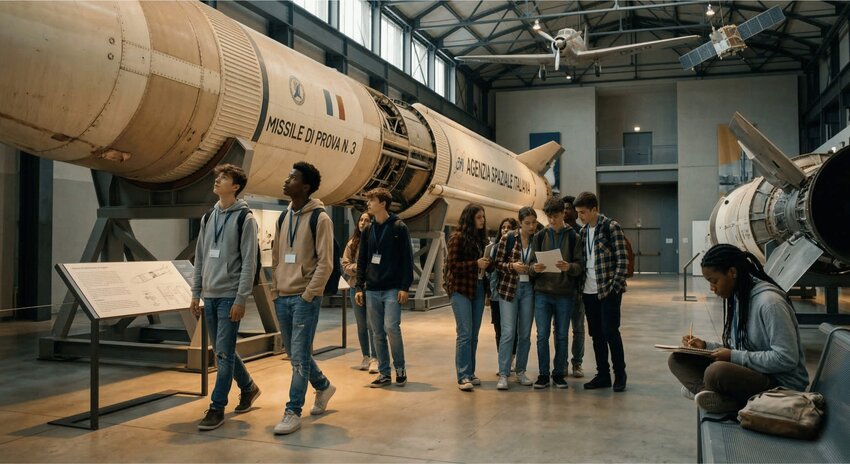
At 16, most young people learned about rockets from a textbook or YouTube video. In the Be Easy aerospace engineering exchange, they learn the equation that NASA and ESA engineers use to plan real missions, within the laboratories of the Sapienza University of Rome, founded in 1303.
The program takes young people aged 15 to 18 to Rome for a 13-night residential immersion divided into three progressive modules. This article explains the first of these, Rocket Engineering & Propulsion, what is taught, how the content connects to the following modules, and why the environment matters as much as the curriculum.
What is the Rocket Engineering & Propulsion module?
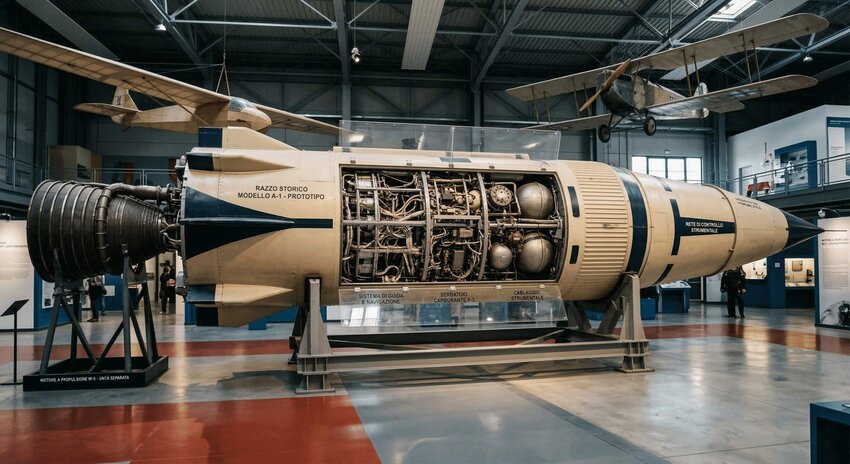
Module 1 of the program covers the scientific foundations that underpin any space mission. It's not a superficial introduction: it's a real-technically-based class, conducted by Sapienza professors and researchers, on how rockets actually work.
The core themes of the module are:
- Applied thermodynamics: How does the combustion of propellants generate gases at high pressure that produce thrust
- Aerodynamics: how do the rocket shape, the conical warhead and the stabilizing fins influence trajectory and air resistance
- Solid propulsion: high immediate thrust, used in military boosters and rockets
- Liquid propulsion: more efficient and controllable, based on orbital rockets like the Falcon 9
- Hybrid propulsion: combination of the previous two, increasingly present in experimental and commercial projects
- Tsiolkovsky equation: The formula that relates final velocity, exhaust velocity, and mass ratio of the rocket
Upon mastering these concepts, young people arrive at Module 2 (Space Mission Simulation & Embedded Systems) already with the technical vocabulary to simulate trajectories, and to Module 3 (Rocket Prototype Development & Launch) prepared to build and launch a real rocket.
Why is the Tsiolkovsky Equation a milestone in learning?
For most participants, contact with the Tsiolkovsky Equation is the first moment in which a mathematical formula ceases to be an exercise and begins to describe reality.
Formulated in 1903 by the Russian mathematician Konstantin Tsiolkovsky, it establishes the relationship between the final velocity of a rocket, the exhaust velocity of the gases generated by the engine, and the ratio between the vehicle's initial mass (with fuel) and the final mass (without fuel). It's the same equation used today by engineers from ESA, NASA, and the world's leading space agencies to plan each phase of a mission.
Learning this equation within a university like Sapienza, with access to researchers working with real space agencies, is different from any conventional classroom explanation. The context changes the weight of the content.
Why is Sapienza University of Rome the right setting for this learning?
Sapienza was founded in 1303 and is one of the largest universities in Europe in terms of number of students and scientific production. Its aerospace engineering school collaborates with the European Space Agency and with leading companies in the sector.
When a young person aged 15 to 18 learns about propulsion in this environment, the impact goes beyond the content. It begins to understand, in practice, how it is a world reference institution. This affects how he projects himself into the future and the choices he makes in the entrance exam, in international university selections, and in his first career opportunities.
The program also includes technical visits to:
- Leonardo S.p.a.: one of the largest aerospace and defense technology companies in the world, with headquarters in Italy and contracts with leading global space agencies
- Pagani Automobili: a world reference in high performance engineering, which connects the program's aerodynamic principles to the cutting-edge automotive universe
- Italdesign & Museum: industrial design and technological innovation, expanding the vision of how engineering and creation are integrated
What does your child develop besides technical content?
Throughout Module 1, participants don't just learn physics. The process of understanding how different systems, combustion, pressure, aerodynamics, and trajectory, form a functional rocket develops systemic thinking: the ability to see how independent parts are integrated into a coherent result.
This skill is valued in any area of engineering, computer science, or project management. It's not specific to the aerospace sector.
Additionally, the program is conducted in English, the language of global aerospace engineering. Contact with technical terminology in a real academic context increases young people's confidence to read scientific articles, participate in science Olympiads, and apply for international programs in the future.
What is the structure of the experience in Rome?
Summer 2026 takes place from July 19th to August 1st, totaling 13 nights under a full residential basis. The package includes lodging, three meals a day, travel insurance, 24/7 support, and a certificate issued at the end of the program.
The continuous coexistence between young people from different countries with the same interests is part of learning. Dinner conversations, cultural activities in Rome, and informal networking between participants create connections that last well beyond the two-week program.
FAQ: frequently asked questions about rocket aerospace engineering exchanges
1. Does the program require prior technical knowledge to participate?No. Module 1 was designed for young people curious about science and technology, not for those who already have technical training. The content begins with the fundamentals and evolves progressively over the three modules.
2. What language is the program conducted in?The program is conducted in English. Fluent proficiency is not mandatory, but an intermediate level makes it easier to enjoy classes and interactions with colleagues from other countries.
3. Is the certificate issued by Sapienza academically valid?The certificate is issued at the end of the program and records participation in academic activities and technical visits. The validity for utilization purposes at specific institutions depends on the policy of each university.
4. What age group is accepted in the program?The program is aimed at young people aged 15 to 18. Candidates outside this range do not fit the profile of the Summer 2026 edition.
5. Are visits to Leonardo S.p.A. and Pagani Automobili included in the package?Yes. Technical visits to Leonardo S.p.a., Pagani Automobili and Italdesign & Museum are part of the official Summer 2026 program and are included in the residential package.
Be Easy
Be Easy Exchange selects and organizes every detail of the aerospace engineering program in Rome, with more than 200 international partnerships and full support from enrollment to the return of your child. If you want to know more about Summer 2026 vacancies or ask questions about the process, contact us.

